
GEORGES BRAQUE,
POMME ET BANANE, 1926

GEORGES BRAQUE
Pomme et Banane
signed, lower left GB
oil on panel
6.5 x 8.7 in. / 16.5 x 22 cm
painted in 1926
Provenance:
● Galerie Maeght, Paris circa 1920
● The Art Gallery of Hamilton, Canada
● Benjamin Weiss, New York
● Jessica Weiss, New York (daughter of B.Weiss)
● Buchhoz Gallery, New York 1981
● Sotheby’s London: Wednesday June 27, 1990 [Lot 0029] Impressionist and modern paintings and sculpture part II
Exhibited:
● Musée Malraux, Le Havre. Georges Braque, 1999, p.60
Literature:
● Cat. des oeuvres de Georges Braque par Georges Isarlov, coll. Orbes, éd. Paris 1932, No 408.
● André Verdet, Braque le Solitaire – XXe siècle. 1958, p. 16, n° XI
● Editions Galerie Maeght, Catalogue de l’oeuvre de Georges Braque 1924–1927, Paris 1962, p. 90
● Pierre Descargues et Massimo Carrà, Toute l'Oeuvre peinte de Braque 1908–1929
COMPARATIVE PAST AUCTIONS
-
Georges Braque, Pomme et banane
Medium : Oil on Panel
Year of Work : 1926
Size : Height 6.5 in.; Width 8.7 in. / Height 16.5 cm.; Width 22 cm.
Signed
Sale of : Sotheby's London: Wednesday, June 27, 1990 [Lot 00229] IMPRESSIONIST AND MODERN PAINTINGS AND SCULPTURE PART II
Estimate : 80,000 - 100,000 GBP (139,421 - 174,276 USD)
Sold For : 88,000 GBP Premium (153,363 USD)
source : ARTNET.COM -
Georges Braque, Poire, deux pommes
Medium : oil on paper laid on canvas
Year of Work : 1924
Size : Height 5.6 in.; Width 8.9 in. / Height 14.3 cm.; Width 22.5 cm.
signed with initials and dated 'GB 24' (lower right)
Sale of : Christie's New York: Thursday, November 4, 2010 [Lot 00352] Impressionist/Modern Day Sale
Estimate : 70,000 - 100,000 USD
Sold For : 134,500 USD PremiumProvenance :
Adolphe A. Juviler, New York.
Galerie Berggruen & Cie., Paris.
Acquired from the above by the family of the present owner, by 1968
source :ARTNET.COM -
Georges Braque, Les deux as
Medium : oil on canvas
Year of Work : 1929
Size : Height 9.6 in.; Width 13.8 in. / Height 24.3 cm.; Width 35 cm.
signed and dated 'G Braque 29' (lower left)Sale of : Christie's London: Tuesday, June 27, 2017 [Lot 00002] Impressionist & Modern Art Evening Sale
Estimate : 300,000 - 400,000 GBP (383,828 - 511,770 USD)
Sold For : 341,000 GBP Premium (436,284 USD)
Provenance :
Paul Rosenberg, Paris & New York, by 1938.
James Pendelton, New York.
E.V. Thaw & Co., New York.
Private collection, United States, by whom acquired in 1971; sale, Christie's, New York, 2 May 2006, lot 44. Acquired at the above sale by the present owner.
source : ARTNET.COM

Pomme et banane
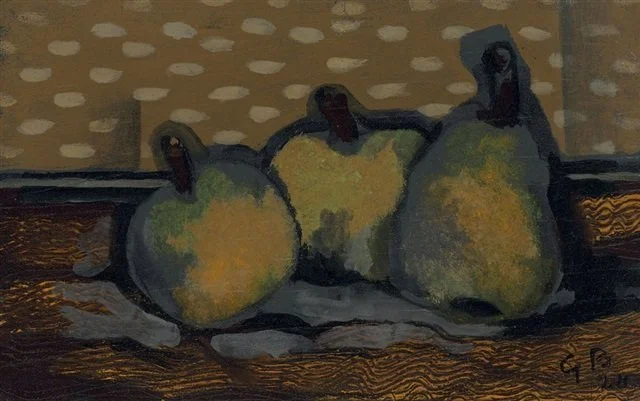
Poire, deux pommes
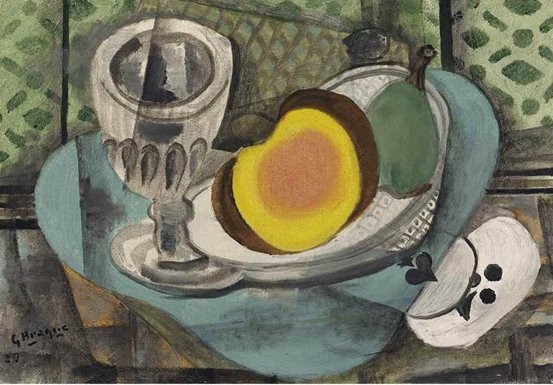
Les deux as
source : ARTNET.COM
DOCUMENTATION
GEORGES BRAQUE, Pomme et Banane, 1926
This is a small-scale work, but an artistically lovely and intimate one. It is, as is very apparent, part of the classic still life genre. The canvas offers us two pieces of fruit (an apple and a banana) sitting on a pearly white cloth, with a decorated wall behind, which serves to close off any background depth and so draw our attention to the subjects in the foreground. However, let’s not forget that what we are dealing with here is a Georges Braque painting, rather than a depiction of pieces of fruit.
The process involved in creating the work remains clearly discernible within it: the colours, texture and strokes all reveal the artist’s steady hand. Formally, we can term the fruit, cloth and wall simplified in their sketching; Braque has done this intentionally, with the aim being to paint, not to offer the mimetic illusion of a reality, whatever reality that may be. He chooses colours which create contrasts, be it light and dark or warm and cool: in the foreground, we have the whites and the orangey-yellows painted in quite thick strokes; at the bottom of the canvas, as well as in the background, we have greys, blacks and dark greens which are yet almost transparent, given the fluidity of the piece’s illustrated material.
The clarity of the work’s texture is more accentuated in some places than others, dependent on whether or not visible brush strokes have been left by the artist. Black lines are a strong feature, bringing out the wrinkles on the fruit and the designs on the background wall, and ensuring the stability of the composition.
There is in this work – whose tight structure gives it an intimate feel – a freedom of artistic gesture, a slickness to the fading and an ability to let go of the shackles when painting. This leaves us with a harmonious blend of strokes, colours and texturing. In other words, the piece conveys a pleasure in painting on the part of the artist.
Georges Braque’s Post Cubist Masterpieces, Anthem Edition, 2024.