
GEORGES BRAQUE,
POIRE, POMME ET COUTEAU, 1924

GEORGES BRAQUE
Poire, Pomme et Couteau
signed, lower right GBRAQUE
oil on panel
6.9 x 10.4 in. / 17.5 x 26.5 cm
painted in 1924
Provenance:
● Galerie Maeght, Paris
● Norbert Schimmel, Great Neck, New York
● Jacques Jourda, Paris
● Sotheby’s London, June 27, 1990, [Lot 00228] Impressionist & Modern Art Day Sale
Exhibited:
● Musée Malraux, Le Havre. Georges Braque, 1999, p. 60
● IVAM, Institut Valencià d’Art Modern, March 16– May 7, 2006
Literature:
● Editions Galerie Maeght, Catalogue de l’oeuvre de Georges Braque 1924–1937, Paris 1962, p. 32
● Pierre Descargues et Massimo Carra, Tout l’oeuvre peint de Braque 1908–1929, Paris, 1978, No. 242
COMPARATIVE PAST AUCTIONS
-
Georges Braque, Poire, pomme et couteau
Medium : Oil on Panel
Year of Work : 1924
Size : Height 6.9 in.; Width 10.4 in. / Height 17.5 cm.; Width 26.5 cm.
Signed
Sale of : Sotheby's London: Wednesday, June 27, 1990 [Lot 00228]
Impressionist & Modern Paintings and Sculpture Part II
Estimate : 80,000 - 100,000 GBP (139,421 - 174,276 USD)
Sold For : 126,500 GBP Premium (220,460 USD)
source : ARTNET.COM -
Georges Braque, Fruits et fourchette
Medium : oil on canvas
Year of Work : 1929
Size : Height 9.4 in.; Width 15.9 in. / Height 24 cm.; Width 40.5 cm.
Signed
Sale of : Sotheby's London: Wednesday, June 20, 2007 [Lot 00477] Impressionist & Modern Art Day Sale
Estimate : 120,000 - 180,000 GBP (237,859 - 356,788 USD)
Sold For : 144,000 GBP Premium (285,431 USD)
source : ARTNET.COM -
Georges Braque, Nature morte à la guitare
Medium : oil, sand and pencil on panel
Year of Work : 1920
Size : Height 5.9 in.; Width 11.7 in. / Height 15 cm.; Width 29.7 cm.
signed 'G Braque' (on the reverse)
Sale of : Christie's Paris: Friday, March 24, 2017 [Lot 00307] Art Impressionniste et Moderne
Estimate : 130,000 - 180,000 EUR (140,449 - 194,468 USD)
Sold For : 182,500 EUR Premium (197,169 USD)Provenance :
Galerie l’Effort Moderne (Léonce Rosenberg), Paris.
Constance Coline, Paris (avant 1940).
Then by descent to the current owner.
source : ARTNET.COM -
Georges Braque, Verre et grappe de raisins
Medium : oil on canvas
Year of Work : 1930
Size : Height 8.7 in.; Width 13.9 in. / Height 22.2 cm.; Width 35.2 cm.
signed and dated 'G Braque 30' (lower left)
Sale of : Bonhams New York: Wednesday, May 14, 2025 [Lot 0017A] 20th/21st Century Art Evening Sale
Estimate : 150,000 - 250,000 USD
Sold For : 178,300 USD Premium
Provenance :
Ilka Chase Collection, New York.
Sale: Finarte, Rome, December 4, 1984, lot 153.
Acquired at the above sale by the present owner.
source : ARTNET.COM
Poire, pomme et couteau
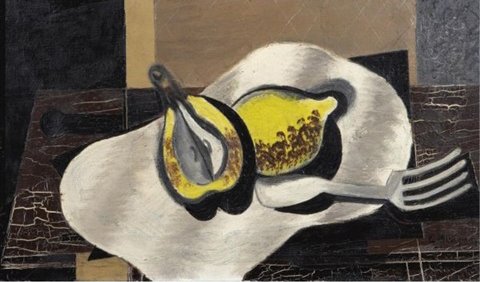
Fruits et fourchette
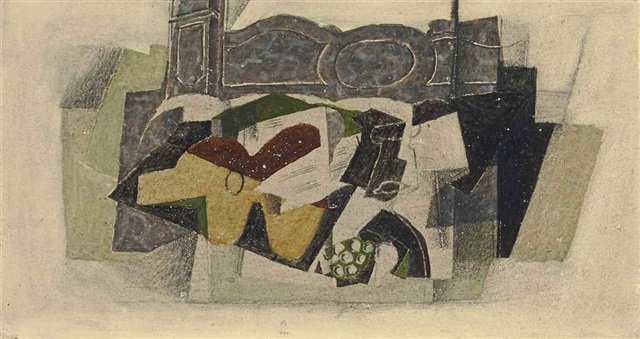
Nature morte à la guitare
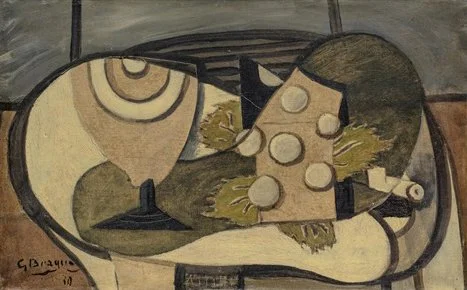
Verre et grappe de raisins
source : ARTNET.COM
DOCUMENTATION
GEORGES BRAQUE, Poire, Pomme et Couteau, 1924
This 1924 oil painting is an intimate work focused on several elements, the principal subject being still life – which, of course, evokes Cubist imagery.
The work is plain, even austere: three ‘figures’ sit dissociated from the background, in spite of their clear interaction with it, through Braque’s colours and texture. These three figures – the pear, apple and knife – are reduced down to their bare bones. Even if Braque is not returning to the fragmented representation of Analytical Cubism here, it is also not a case of Braque turning to a mimetic style, one which he elsewhere used only very rarely, even at the outset of his career.
The piece’s composition emphasises the horizontality of its setup, reinforced by the horizontal line separating the two block colours in the background. The knife inserts one diagonal, whilst the two lined-up pieces of fruit form another, in the opposite direction.
The artistic evolution of Cubism is totally integrated here; particularly, we see a reduction in perspective: the subjects give the impression of being compressed into the foreground. This front-facing nature is even clearer given how the flatness of the work’s materiality is accentuated by the sand beneath the canvas’ surface. The depiction of a knife would also typically, in still life, subtly indicate a hollowing out of the space; instead, in this work, it creates a front-facing, shallow diagonal.
The oil painting’s colours are both understated and restrained: greys, yellows, blacks and browns, as well as their various shades, run across the entire surface of the canvas, creating marked contrasts. The pear’s cross-section forms a flat, milky-white area, cutting sharply against all the darker colours on the canvas. Several black shadows – such as those around the fruit – also accent the piece’s dark, deep quality. Finally, we notice how the composition becomes centrally focussed, given both the consistent use of black and dark grey contouring to underscore the objects’ outlines and the uniformity of certain background colours.
Although this era of Braque’s work is often seen as more ‘Classical’ than the Cubist period, this painting certainly contains all the artistic features of a truly modern style.
Georges Braque’s Post Cubist Masterpieces, Anthem Edition, 2024.