
GEORGES BRAQUE,
THÉIÈRE ET SERVIETTE, 1942

GEORGES BRAQUE
Théière et Serviette
signed, lower left GBRAQUE
certificate signed by Quentin Laurens
oil on paper mounted on canvas
19.3 x 24.8 in. / 49 x 63 cm
painted in 1942
Provenance:
● Galerie Louise Leiris, Paris
Exhibited:
● Kunsthalle, Berne et Kunsthaus, Zürich, 1953, Braque no. 105
● Haus der Kunst, München, Georges Braque 1963
● Hommage à Georges BRAQUE, Honfleur, 1964, Salle des exposition du Grenier à Sel, Société des Artistes Honfleurais
Literature:
● Cahiers d’Art 1937 No 1–3, p. 96
● Au pochoir, ed. Spitzer, Paris Schweiz, No 4, April 1953
● Editions Galerie Maeght, Catalogue de l’oeuvre de Georges Braque 1942–1947, Paris 1962, p. 17
● Marco Valsecchi et Massima Carrà, L’Opéra Completa di Braque, Milan 1971, p. 106, No 436
COMPARATIVE PAST AUCTIONS
-
Georges Braque, La desserte II
Medium : oil on canvas
Year of Work : 1941
Size : Height 13.6 in.; Width 35.6 in. / Height 34.5 cm.; Width 90.5 cm.
signed
Sale of : Sotheby's London: Tuesday, June 28, 1988 [Lot 00059]
Impressionist & Modern Paintings and Sculpture
Estimate : 120,000 - 150,000 GBP (206,150 - 257,687 USD)
Sold For : 280,500 GBP Premium (481,875 USD)
source : ARTNET.COM -
Georges Braque, Pichet, compotier et plat de fruits
Medium : oil on canvas
Year of Work : 1943
Size : Height 18.1 in.; Width 24 in. / Height 46 cm.; Width 61 cm.
signed G Braque (lower right)
Sale of : Sotheby's Paris: Wednesday, April 19, 2023 [Lot 00011]
Le Souffle moderne – Une collection Parisienne
Estimate : 100,000 - 150,000 EUR (109,541 - 164,311 USD)
Sold For : 317,500 EUR Premium
Provenance :
Private collection, Paris
Thence by descent to the present owner
source : ARTNET.COM -
Georges Braque, Vase et fruits
Medium : oil on paper & pencil laid on canvas
Year of Work : 1942
Size : Height 19.3 in.; Width 23.6 in. / Height 49 cm.; Width 60 cm.
signed
Sale of : Christie's London: Monday, November 27, 1989 [Lot 00057] Impressionist and Modern Paintings and Sculpture.
Estimate : 250,000 - 350,000 GBP (390,015 - 546,021 USD)
Sold For : 528,000 GBP Premium (823,712 USD)
Sold For : 528,000 GBP Premium (823,712 USD)
source : ARTNET.COM
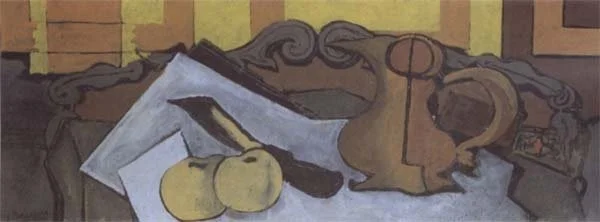
La desserte II
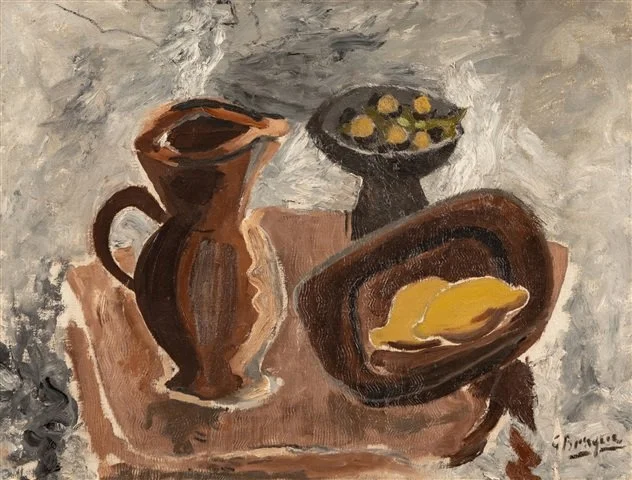
Pichet, compotier et plat de fruits
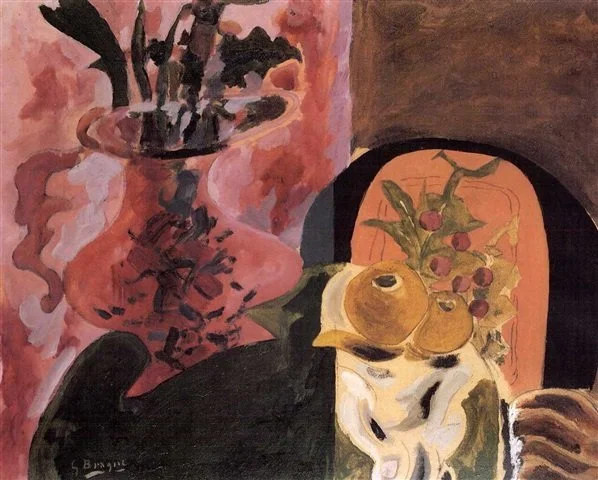
Vase et fruits
source : ARTNET.COM
DOCUMENTATION
GEORGES BRAQUE, Théière et Serviette, 1942
This oil painting, from 1942, was done on paper and mounted on a canvas. It is quite fluid, thanks to the artist’s brush strokes and the work’s texture.
The painting’s look is largely a product of its two-dimensionality; all the elements of this composition emphasise its front-facing nature, owing to the almost overpowering presence of a dark blue and brown-beige background. That background is covered in decorative shapes that come across as geometric and lacking in depth. The objects – that is: the napkin, the table and the teapot – are seized upon by the background, meaning that they do not necessarily grab the viewer’s attention immediately. In Classical or Academic art, objects are represented very clearly against a background. In this work, by contrast, the background comes forward and itself dulls the visibility of the objects. The two parts of the work – ‘figures’ and background – are no longer meaningfully separated, instead seeming to be morphed together. The background, with its decorative marks, becomes a central part of this work, pervading the space inhabited by the figures. Georges Braque signals a clean break from the usual order of things in painting: no longer do the objects dominate over the background, but it is the decorative background itself which becomes the painting’s real theme.
All the central aspects of Modern Art can be seen in this painting, including the front-facing nature of the material, forms and colours, which lead to a reduction in perspective. In addition, we see a simplified style, a clear visibility of the artist’s brush strokes and an abandonment of local colour. This is all in absolute opposition to a mimetic style. The way that the piece is created is now a product not of the objects it represents, but of the painting’s own fundamental balance and harmony.
Georges Braque’s Post Cubist Masterpieces, Anthem Edition, 2024.