
GEORGES BRAQUE,
NATURE MORTE AUX FRUITS ET FOURCHETTE, 1942

GEORGES BRAQUE
Nature Morte aux Fruits et Fourchette
certificate signed by Quentin Laurens
oil on paper mounted on canvas
25.4 x 19 in. / 64.5 x 48 cm
painted in 1942
Provenance:
● Galerie Louise Leiris, Paris
Exhibited:
● Sala Gaspar, Barcelona. 19 Paintings, Georges Braque 1919–1962. January 1975, No 4
COMPARATIVE PAST AUCTIONS
-
Georges Braque, Pichet, poire coupée, verre
Medium : oil on panel
Year of Work : 1929
Size : Height 9.5 in.; Width 16.1 in. / Height 24.1 cm.; Width 40.9 cm.
signed G. Braque and dated 29 (lower right)
Sale of : Sotheby's London: Wednesday, February 9, 2011 [Lot 00268] Impressionist & Modern Art Day Sale
Estimate : 180,000 - 250,000 GBP (289,575 - 402,187 USD)
Sold For : 253,250 GBP Premium (407,416 USD)
Provenance :
Paul Rosenberg Gallery, New York
Mr & Mrs H. Gates Lloyd, Washington, D.C. (acquired from the above in 1944; sale: Sotheby's, New York, 12th May 1994, lot 202)
Private Collection (purchased at the above sale)
Acquired by the present owner by the late 1990s
source : ARTNET.COM -
Georges Braque, Pichet, pipe, tabac
Medium : oil on panel
Year of Work : 1928
Size : Height 10.6 in.; Width 16.1 in. / Height 27 cm.; Width 41 cm.
Signed, Inscribed
Sale of : Conan Hôtel d'Ainay: Saturday, June 13, 2020 [Lot 00234]
MOBILIER ET OBJETS D‘ART, TABLEAUX ANCIENS ET MODERNES
Estimate : 180,000 - 220,000 EUR (202,657 - 247,691 USD)
Sold For : 270,000 EUR Premium (303,985 USD)
Provenance :
Roger Dutilleul Collection, kept in the family since then.
Export certificate for cultural property No. 180004, issued on 21.11.2016.
source : ARTNET.COM -
Georges Braque, Pichet et fruits
Medium : oil on canvas
Year of Work : 1935
Size : Height 9.4 in.; Width 13 in. / Height 23.8 cm.; Width 33 cm.
signed G Braque (lower right)
Sale of : Sotheby's New York: Wednesday, May 17, 2017 [Lot 00146] Impressionist & Modern Art Day Sale
Estimate : 250,000 - 350,000 USD
Sold For : 492,500 USD Premium
Provenance :
Galerie Zak, Paris
Acquired from the above by 1963
source : ARTNET.COM

Pichet, poire coupée, verre
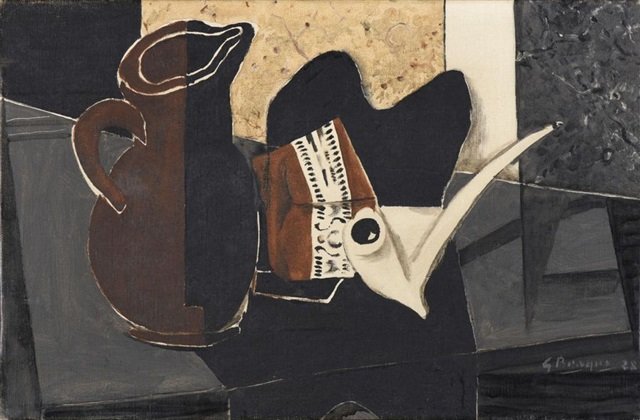
Pichet, pipe, tabac
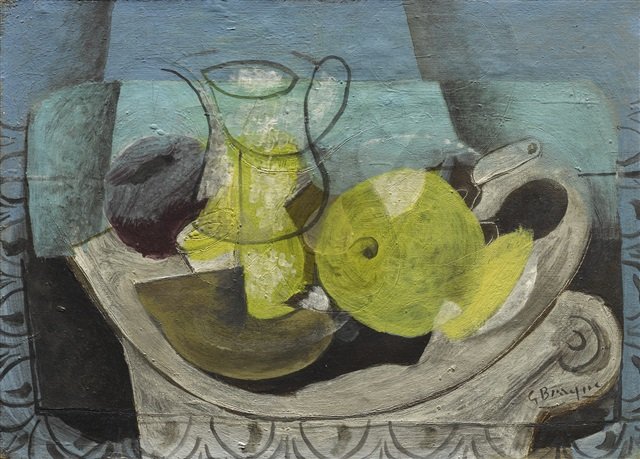
Pichet et fruits
source : ARTNET.COM
DOCUMENTATION
GEORGES BRAQUE, Nature Morte aux Fruits et Fourchette, 1942
This 1942 work of Braque’s depicts a large vase and cutlery on a table, where a fruit bowl (or, simply, a dish containing some fruit) also lies.
The manner in which this work was composed remains very discernible within the canvas: brush strokes are present throughout, on every element, creating fading, shades and textures of differing thickness across the entire surface. In places, the piece lacks any artistic material whatsoever, creating what could be described as non-finito (unpainted areas) within the painting.
As in many of his paintings, Braque allows for a clear gap between the real-life objects that he is representing and the forms that he uses to paint them. He draws these objects schematically, with some of the features even entirely broken down. Numerous curved lines run across the composition, creating an impression of lightness and fluidity. Aside from the window in the top right, the whole piece is very dynamic indeed. The painter’s own efforts are openly on-show for the viewer: the physical materiality of the piece, its borders, its front-facing nature, the graining, the indelible mark of Braque’s brush strokes and the colours he uses all come across as structural elements of the work. In fact, they become, in and of themselves, the true driving force behind the painting. It feels as if the material details create an ‘organic’ whole; the textural and chromatic aspects take over from the actual coherence of the scene.
Colour, therefore, becomes a central concern in this work: a grey-blue tone is present across the entire painting; a number of shades form part of this, with dark greys (which are, indeed, practically black), light greys, blue-greys and light blues. The hints of white and the un-painted areas, which appear to be light beige, underwrite this further. This whole aspect of the work is further emphasised by the presence of yellow and emerald green on the fruit bowl, which creates a subtle, warm-cool contrast.
This piece’s style is totally different from those of earlier periods – it contains various, very modern characteristics.
Georges Braque’s Post Cubist Masterpieces, Anthem Edition, 2024.