
GEORGES BRAQUE,
BAIGNEUSE II, 1930–1931

GEORGES BRAQUE
Baigneuse II
signed, lower right GBRAQUE
oil on canvas
8.7 x 13.8 in. / 22 x 35 cm
painted in 1930–1931
Provenance:
● Georges Renand, Paris
● Christie's London: Tuesday, December 3, 1996 [Lot 00281] Impressionist and Modern Paintings, Watercolours and Sculpture (Part II)
Exhibited:
● Paris, Musée National d’Art Moderne, Depuis Bonnard, 1957, no 53.
The exhibition later travelled to Munich.
Literature:
● Editions Galerie Maeght, Catalogue de l’oeuvre de Georges Braque 1928–1935 Paris 1962, p. 63
COMPARATIVE PAST AUCTIONS
-
Georges Braque, Baigneuse II
Medium : Oil on Canvas
Year of Work : 1930-1931
Size : Height 8.7 in.; Width 13.8 in. / Height 22 cm.; Width 35 cm.
Signed
Sale of : Christie's London: Tuesday, December 3, 1996 [Lot 00281] Impressionist and Modern Paintings, Watercolours and Sculpture (Part II)
Estimate : 30,000 - 40,000 GBP (49,261 - 65,681 USD)
Sold For : 111,500 GBP Premium (183,087 USD)
source : ARTNET.COM -
Georges Braque, Nu couché
Medium : Oil on Canvas
Year of Work : 1935
Size : Height 45 in.; Width 77 in. / Height 114.3 cm.; Width 195.6 cm.
Signed
Sale of : Sotheby's New York: Tuesday, May 13, 1997 [Lot 00035] Impressionist and Modern Art, Part I
Estimate : 800,000 - 1,000,000 USD
Sold For : 1,872,500 USD Premium
source : ARTNET.COM -
Georges Braque, Nu couché au guéridon
Medium : Oil on Canvas
Year of Work : 1931-1931
Size : Height 9.4 in.; Width 16.1 in. / Height 24 cm.; Width 41 cm.
Sale of : Christie's New York: Wednesday, November 7, 2001 [Lot 00256] Impressionist and Modern Art (Day Sale)
Estimate : 90,000 - 120,000 USD
Sold For : 182,000 USD Premium
source : ARTNET.COM
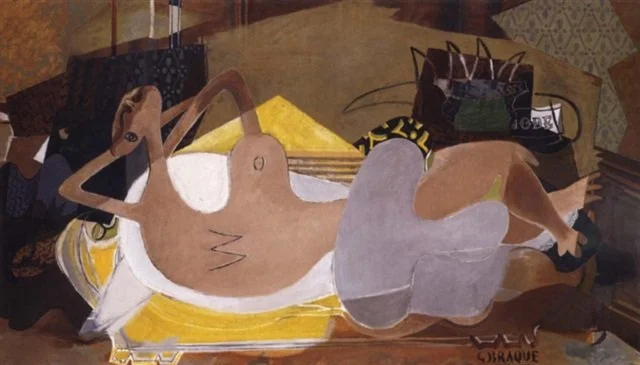
Nu couché
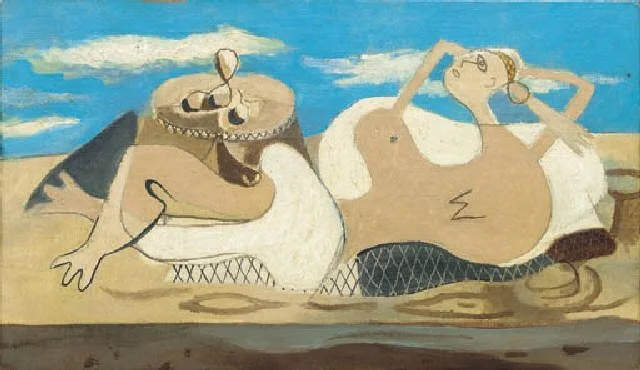
Nu couché au guéridon

Baigneuse II
source : ARTNET.COM
DOCUMENTATION
GEORGES BRAQUE, Baigneuse II, 1930–1931
This painting – which follows on from Braque’s Baigneuse (sur les galets) of 1929 – contains several noteworthy features. The female nude in it appears distorted and fragmented, with the artist presenting her both from a side view (her body offers us this) and a frontal view (with her head on the left-hand side). There is hardly any meaningful distinction between the background and the shape representing the woman. Both angular and curved forms fill the entire canvas: the curves on the towel echo those of the bather’s body, but they could also bring to mind the curves of waves. Meanwhile, the meeting point of the white oval and the curved lines around it could be evoking certain Cubist motifs, such as the guitar or the mandolin.
The whole work is both geometrically depicted and front facing: Braque does away with linear perspective here. Multiple, consecutive points of view are compressed onto the canvas’ flat two-dimensional structure. With visible brush strokes, the artist’s own efforts remain discernible on the painting through his employment of dotted and curved lines. The colour here, just as in the first Baigneuse, almost becomes a camaïeu, which then contains some more chromatic touches; the (light) blue and khaki green bring this aspect to the canvas. As for the texture, the work’s thickness varies depending on what the artist is focussing on; as such, the bottom of the canvas contains more textural and material effects. The horizontal structure of the painting echoes the bather’s own horizontality, as she lies on what appears to be a towel.
This work is quite clearly reminiscent of the earlier periods of Analytical and Synthetic Cubism. In it, the figure is no longer a completely separate entity from the background – which renders it totally at odds with the style of painting in Classical and Academic art.
Georges Braque’s Post Cubist Masterpieces, Anthem Edition, 2024.